
Tryonixs Blog
Virtual Try-On for Ecommerce: How AI, AR, and Computer Vision Are Changing How People Shop
A practical guide to virtual try-on for ecommerce — how AI, augmented reality, and computer vision power real-time previews for eyewear, sunglasses, foundation, and lipstick, and what merchants gain on Shopify.
You found the perfect pair of glasses on a brand's website. The photos look great. The reviews are solid. But you still aren't sure they'll suit your face shape — so you leave without buying.
That moment of hesitation costs ecommerce brands billions of dollars every year. Virtual try-on for ecommerce was built specifically to eliminate that hesitation. It lets shoppers see how glasses, sunglasses, lipstick shades, or foundation tones look on their face — in real time, using the camera on their phone or laptop — before they click Add to Cart.
This guide explains how the technology works, which brands benefit most, and what to look for when choosing a virtual try-on platform for your store.
Why Online Shopping Still Has a "Try Before You Buy" Problem
Ecommerce has made it easier than ever to discover and purchase products. But it has not solved one fundamental problem: you cannot physically try something on before it arrives.
The return rate problem
Returns are one of the most expensive parts of running an online store. According to the National Retail Federation, online return rates hover around 17–20% across categories, and in fashion and beauty, they climb higher. For eyewear specifically, the "wrong look" and "didn't suit me" reasons appear in a large share of return requests.
Every return erodes margin. You absorb shipping costs in both directions, repackaging labor, and often the cost of inspecting or refurbishing the product. Virtual try-on helps shoppers make better-matched choices before purchase — a direct lever for reducing ecommerce returns.
The confidence gap
Even when shoppers don't return a product, many experience buyer's remorse. They chose a frame style that looks different in person. The lipstick shade was more orange than it appeared on screen. The foundation was half a shade too light.
Virtual try-on closes this gap. When a shopper can see exactly how a product looks on their face before buying, they purchase with more confidence, return less, and report higher satisfaction.
What Is Virtual Try-On Technology?
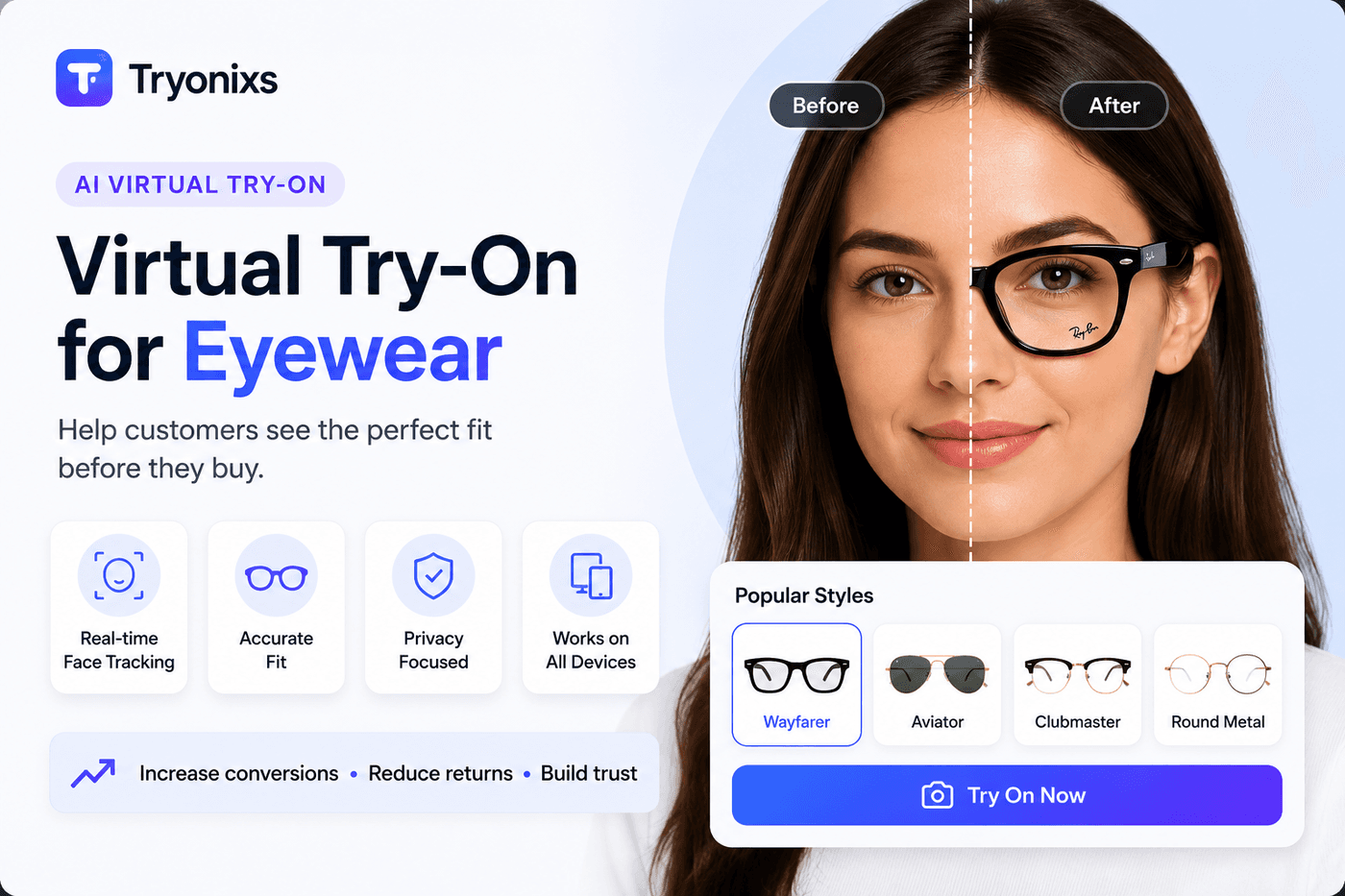
Virtual try-on (VTO) is a feature that overlays a digital version of a product onto a live or static image of a user, so they can preview how it will look on them personally.
- The shopper opens the camera on their device.
- The system detects their face using computer vision.
- A digital version of the product — glasses, lipstick, foundation — is rendered in real time on top of their face.
- The shopper can move, tilt their head, or adjust the product to explore options.
The result feels closer to standing in front of a dressing room mirror than browsing a product page.
How it differs from traditional product photography
Standard product photography shows a product on a model. Skin tone, face shape, and facial proportions all affect how a product looks in practice — and no single model can represent every potential customer. Virtual try-on personalizes the preview. Every shopper sees the product on themselves, not on someone else.
Which product categories benefit most
Virtual try-on delivers the clearest value in categories where fit, color, and proportion matter:
- Eyewear and sunglasses: Frame shape and size relative to face structure
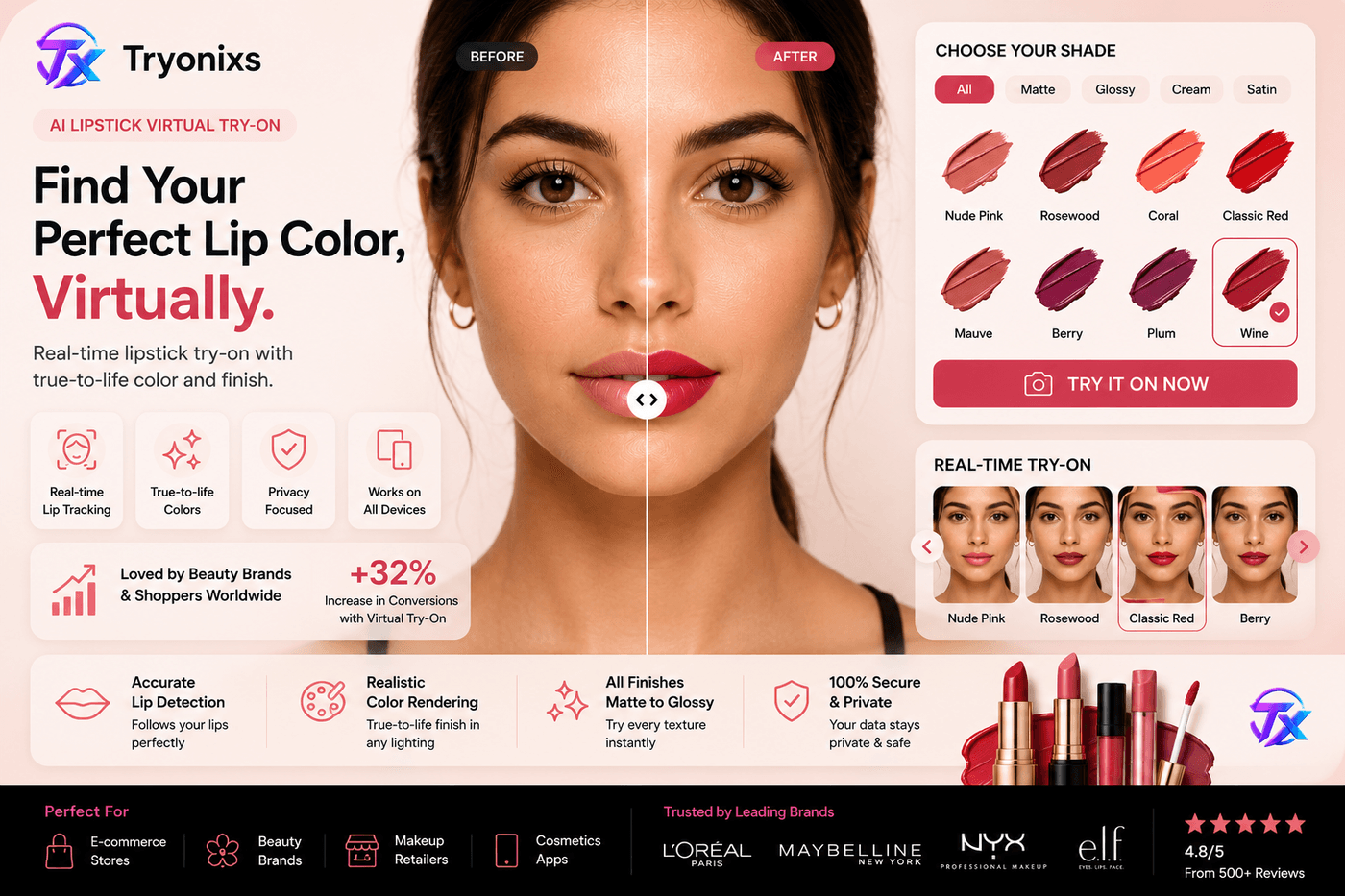
- Lipstick: Shade appearance on individual skin tones
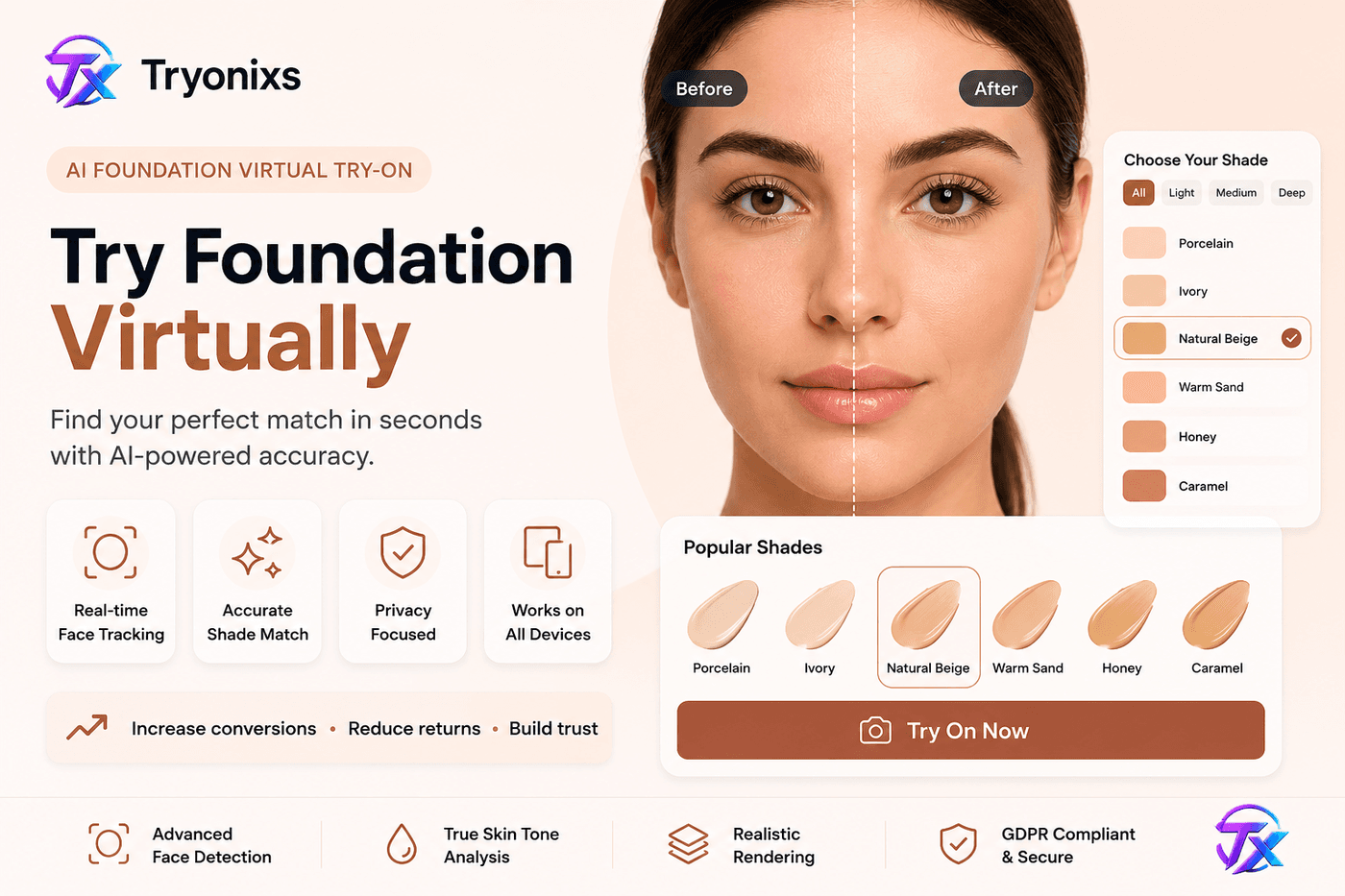
- Foundation: Undertone and coverage matching
- Accessories and jewelry: Scale and positioning
The Technology Behind Virtual Try-On
A polished virtual try-on experience is the result of several distinct technologies working together seamlessly.
Artificial Intelligence (AI)
AI is the engine that makes VTO intelligent rather than mechanical. In virtual try-on, AI handles product mapping, skin tone analysis, lighting adaptation, and personalization over time — the same recommendation logic applied to retail.
Augmented Reality (AR)
Augmented reality try-on overlays digital content onto the real world. In VTO, AR makes glasses sit on the nose bridge correctly and lipstick conform to lip shape using depth estimation, anchor points, and occlusion handling.
Computer Vision
Computer vision ecommerce applications rely on face detection, landmark detection, and segmentation — distinguishing lips, nose, and eye area from background. The accuracy of computer vision directly determines overlay quality as shoppers move.
Real-Time Face Tracking
Face tracking maintains landmark mapping continuously across frames. High-quality tracking runs at 30 frames per second or higher so the experience feels live rather than choppy — essential for real-time face tracking for ecommerce.
How Tryonixs Works
Tryonixs is an AI-powered virtual try-on platform designed for ecommerce merchants who want to give shoppers a genuine preview of products before they buy.
Supported product categories
- Eyewear (prescription frames and fashion glasses)
- Sunglasses
- Foundation (shade matching across skin tones)
- Lipstick
Explore live demos for each category on the Tryonixs demo hub — eyewear, foundation, and lipstick try-on run directly in your browser.
The shopper experience
- One click to activate: No app download, no account creation.
- Camera access request: Standard browser permission.
- Instant overlay:Product appears on the shopper's face in real time.
- Browse multiple options: Try different frames or shades without leaving the page.
- Add to Cart: Purchase when ready.
Integration with Shopify
Tryonixs is built with Shopify merchants in mind. Products sync to your catalog, try-on runs on your storefront, and no custom development is required to get started. See the Shopify integration guide for implementation details.
Benefits for Shoppers
- Confidence before purchase:See products on your own face, not a model's.
- Faster decisions: Try options directly instead of comparing tabs.
- Reduced regret: Align expectations with reality before checkout.
- More enjoyable shopping: Exploration increases time on product pages.
- Accessibility: In-store trial experience from anywhere.
Benefits for Merchants and Brands
Beauty brands
Virtual try-on solves color accuracy at the source. Shoppers preview shades on their skin, in their lighting — reducing "wrong color" returns and encouraging shade exploration. Try the lipstick try-on and foundation shade finder demos to see how Tryonixs handles beauty categories.
Eyewear and optical retailers
Glasses are deeply personal. Virtual try-on lets shoppers compare frame shapes, assess relative size, and reduce costly optical returns. See eyewear virtual try-on in action.
Shopify store owners
Virtual try-on is a competitive differentiator for independent merchants. Practical benefits include conversion lift among VTO users, longer session time, lower return costs, and omnichannel consistency. Review Tryonixs pricing to find a plan that fits your catalog size.
Mobile commerce note: A significant share of ecommerce traffic is mobile. Virtual try-on is native to mobile — the front-facing camera powers the same session shoppers use for selfies.
Comparison Table: Traditional Ecommerce vs Virtual Try-On Ecommerce
| Feature | Traditional Ecommerce | Virtual Try-On Ecommerce |
|---|---|---|
| Product preview | Static photos of a model | Real-time overlay on shopper's face |
| Personalization | Same images for every shopper | Individual preview on each shopper |
| Purchase confidence | Moderate — reviews and guesswork | High — see exactly how it looks |
| Return rates | Higher for fit and color issues | Lower — fewer false assumptions |
| Conversion rate | Baseline | Higher among VTO users |
| Mobile experience | Standard image browsing | Native — uses front-facing camera |
| Suitable for beauty | Limited color accuracy by screen | AI adjusts to individual skin tone |
| Suitable for eyewear | Hard to visualize frame fit | Frame shape and scale on actual face |
| Implementation effort | Minimal — already standard | Low with Tryonixs Shopify integration |
Key Benefits of Virtual Try-On
For shoppers
- See products on their own face before buying
- Reduce purchase regret and the hassle of returns
- Discover new styles and shades with zero risk
- Shop from anywhere, on any device
For merchants
- Decrease return rates and associated costs
- Increase conversion rates among VTO users
- Extend session time and product discovery
- Differentiate from competitors using static images only
For beauty brands
- Match foundation shades accurately to individual skin tones
- Encourage shade exploration and multi-product purchase
- Reduce color-mismatch complaints in reviews and support
For eyewear retailers
- Convert hesitant shoppers who would wait for in-store visits
- Reduce costly returns of custom-fitted lenses
- Deliver online confidence comparable to physical frame trials
Real-World Use Cases
A beauty brand reduces returns by adding lipstick try-on
A cosmetics brand selling 40 lipstick shades saw shoppers misjudging undertones — warm nudes looked orange on cool-toned customers. After adding real-time lipstick try-on, the "wrong color" return category dropped, and shoppers who used try-on were more likely to purchase two or more shades per session.
An optical retailer converts mobile visitors with AR glasses
An optical retailer getting significant mobile traffic from social ads saw low conversion — shoppers browsed but visited physical stores instead. Virtual glasses try-on turned mobile visits into active decisions. Shoppers tried frames from the ad on their own face without leaving the product page.
Foundation shade finder reduces wrong-shade complaints
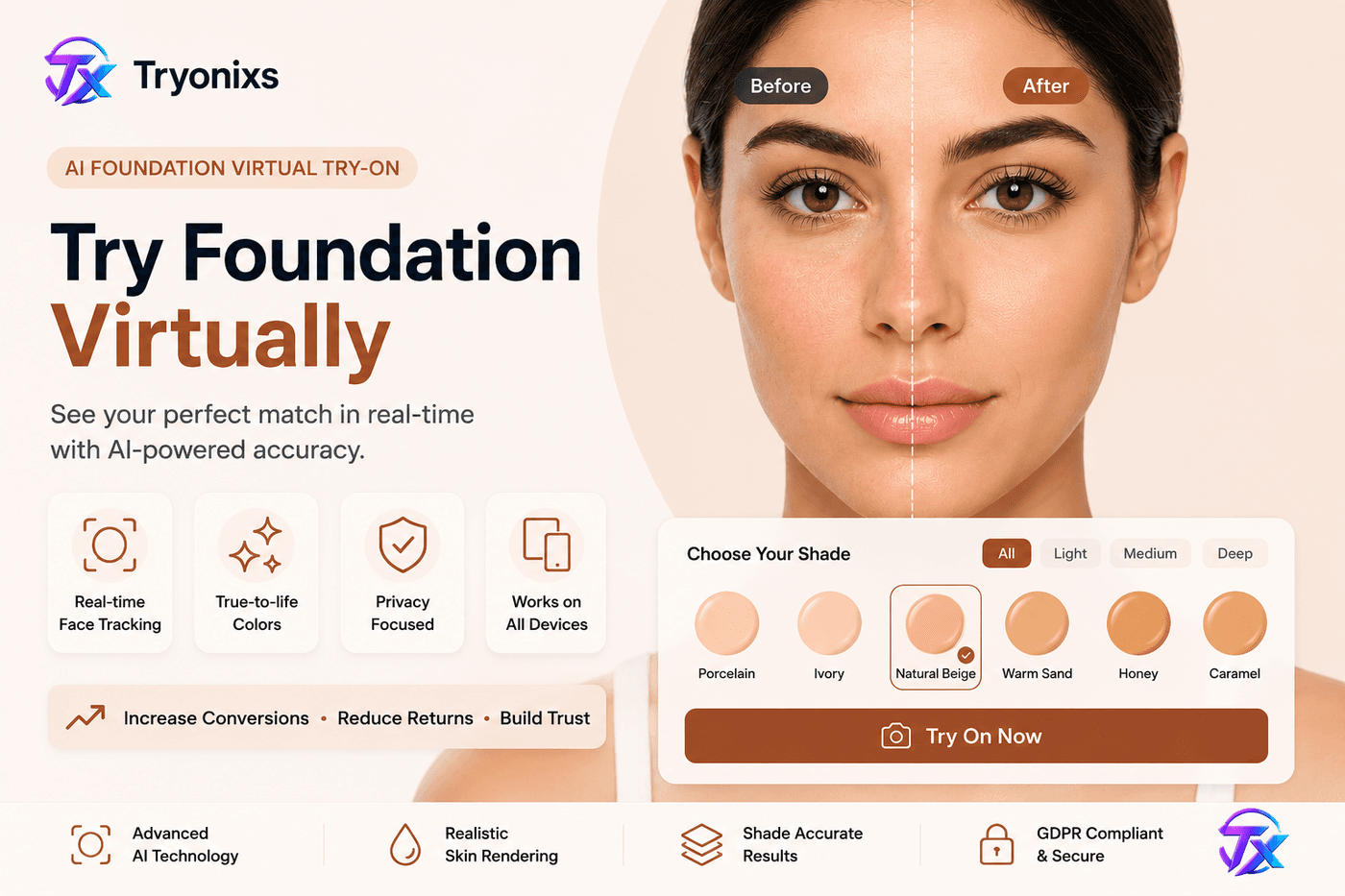
A clean beauty brand managing "too pink" and "too yellow" support requests added an AI-powered shade finder that detected skin tone from the camera and recommended the closest foundation shade — with real-time coverage preview on the shopper's face.
Common Mistakes Brands Make With Virtual Try-On
- Not introducing the feature clearly:Placement and button copy matter — "Try it on your face — no download needed" helps discovery.
- Skipping mobile optimization: Most VTO sessions happen on mobile.
- Using low-quality 3D product models: Inaccurate assets increase returns rather than reducing them.
- Launching with too few products enabled: Prioritize bestsellers and high-return SKUs first.
- Not measuring VTO engagement separately: Track try-on activated and add-to-cart after try-on to see ROI.
The Future of Virtual Try-On
Virtual try-on is an accelerating technology. Computer vision models will handle more face shapes and lighting conditions. Product categories will expand beyond glasses and lipstick to earrings, hair color, and more. AI recommendations will connect try-on behavior to personalized product suggestions. Social sharing and omnichannel continuity will link online try-on sessions to in-store experiences.
For ecommerce brands, the time to implement virtual try-on isn't when it becomes standard — it's now, while it still sets you apart.
Conclusion
Virtual try-on is one of the most practical tools available to ecommerce brands right now. It plugs into your existing product pages and helps shoppers feel confident enough to buy. The technology — AI, augmented reality, computer vision, real-time face tracking — is sophisticated under the hood, but the shopper experience is simple: open the camera, see the product on your face, decide.
For brands in eyewear, sunglasses, lipstick, and foundation, the fit between product type and VTO is almost perfect. The brands adding VTO now are reducing returns, learning which products work for which customers, and building an advantage before VTO becomes table stakes.
For a deeper technical comparison of platforms and SDK architecture, read our virtual try-on software guide. Follow Tryonixs on Facebook, Instagram, LinkedIn, X, TikTok.
Ready to add virtual try-on to your store?
Tryonixs works with your Shopify store, requires no app download from shoppers, and puts your products on your customers' faces in real time. Request a demo and see how the technology looks on your product catalog.
Frequently asked questions
What is virtual try-on?
Virtual try-on is a technology that overlays a digital version of a product — glasses, lipstick, foundation — onto a live camera feed of the shopper's face, so they can see how the product looks on them before purchasing.
How does virtual try-on work technically?
VTO combines AI (for product rendering and skin tone analysis), augmented reality (for overlaying 3D product models onto the face), and computer vision (for detecting and tracking facial landmarks in real time). The shopper's camera provides the video input; the system processes it frame by frame to maintain the overlay.
Does virtual try-on require an app download?
Not with modern browser-based implementations. Tryonixs runs directly in the web browser using Web APIs for camera access, meaning shoppers can use it on any device with a camera without downloading anything.
Which products work best with virtual try-on?
Products where individual fit, color, and proportion matter most — eyewear, sunglasses, lipstick, and foundation — see the greatest impact. These categories have high return rates driven by "didn't suit me" or "wrong color" reasons, which VTO directly addresses.
Does virtual try-on work on mobile devices?
Yes. Modern VTO platforms including Tryonixs are built for mobile-first use, leveraging the front-facing camera on smartphones and tablets. Since mobile drives a large share of ecommerce traffic, mobile compatibility is essential.
How accurate is AI-powered foundation shade matching?
Accuracy depends on the quality of the underlying AI model and the calibration of the product's digital representation. Good VTO systems analyze skin tone, undertone, and ambient lighting to generate a realistic rendering — though in-person lighting and individual skin variation mean the result is a close approximation, not a guaranteed match.
Can virtual try-on reduce ecommerce return rates?
It can, particularly in categories where returns are driven by fit and color issues. When shoppers make purchase decisions based on how a product looks on their own face rather than on a model's, they arrive at better-matched choices and are less likely to return because of "not what I expected."
Is virtual try-on compatible with Shopify?
Yes. Tryonixs integrates directly with Shopify, syncing your product catalog automatically so the try-on feature can be enabled for selected or all products without custom development.
How does augmented reality differ from virtual reality in retail?
Virtual reality (VR) replaces the real world with a digital environment and requires a headset. Augmented reality (AR) overlays digital content onto the real world — in this case, overlaying a product onto the shopper's live camera feed. AR is accessible on any smartphone or laptop and doesn't require special hardware.
What is computer vision and why does it matter for virtual try-on?
Computer vision is the branch of AI that allows software to interpret visual input — detecting objects, faces, and spatial relationships in images or video. In VTO, it identifies and tracks facial landmarks (eye corners, nose bridge, lip outline) so the product overlay attaches accurately and stays in place as the shopper moves.
Will virtual try-on work for shoppers with glasses or unusual lighting?
High-quality VTO systems handle common real-world conditions including ambient lighting variation. Extreme conditions (very dark environments, direct backlight) can reduce accuracy. Wearing existing glasses may affect face tracking for the eyewear category but typically doesn't interfere with lip or foundation overlays.
How long does it take to set up virtual try-on on a Shopify store?
With a platform like Tryonixs, setup is designed to be fast — integration connects your existing Shopify product catalog without requiring custom code. The main time investment is ensuring your product models are high-quality and correctly mapped.
Does virtual try-on improve conversion rates?
Data consistently shows that shoppers who engage with a VTO feature convert at higher rates than those who don't. The act of trying a product — even virtually — creates a sense of ownership and commitment that nudges people toward purchase.
How does virtual try-on help with omnichannel retail?
VTO gives online shoppers an experience closer to what a physical store offers. Shoppers who use VTO online arrive at physical stores more informed and more decided. For brands with both online and offline presence, VTO supports a more consistent customer journey across both.
Is virtual try-on data private?
Reputable VTO platforms process the camera feed locally in the browser and do not store facial images or biometric data on external servers. Shoppers should always review the platform's privacy policy, and merchants should ensure their chosen provider is transparent about data handling.
Can small brands afford virtual try-on?
VTO was once exclusively available to large brands with significant technology budgets. Platforms like Tryonixs are built to make it accessible to Shopify merchants of any size, with pricing structured to fit smaller catalogs and growing businesses.
What's the difference between a 2D and 3D virtual try-on?
A 2D VTO places a flat image of the product on the face — it's simpler to implement but can look artificial, especially for eyewear that should wrap around the face. A 3D VTO uses a genuine three-dimensional model of the product and adjusts it based on face depth and angle, producing a much more realistic result.
Does virtual try-on work for all skin tones?
It should. A well-built VTO system trains its AI on diverse datasets covering a wide range of skin tones, undertones, and lighting conditions. When evaluating VTO platforms, this is worth testing directly with a range of volunteers.
Follow Tryonixs
Connect with Tryonixs on social media for AR virtual try-on updates, product launches, and eyewear technology insights.
Ready to add virtual try-on to your store?
Start free with Tryonixs — 15 products, unlimited try-on sessions, Shopify and WooCommerce integrations included.